

KNOW YOUR BONES
Get facts about bone health and resources like the Calcium Calculator.

QUICK HEALTH TIP
Add ¼ cup of milk to your soup for an added calcium boost!



BONE HEALTH*
HAS NEVER LOOKED SO GOOD
Your favorite bone health formula* is now even easier to find at your local retailer.

DO YOU GET ENOUGH CALCIUM
FROM DIET ALONE?
If you’re like 57% of American women, you probably don’t. Find out why you can trust calcium supplements, like Caltrate to fill your nutritional gap.

THE STORY OF YOUR BONES:
CALCIUM AT EVERY AGE
Calcium plays a key role throughout each stage of your life. Find out what your calcium needs are.

NOTHING HAS MORE VITAMIN D3† THAN CALTRATE
TO HELP NOURISH STRONGER, HEALTHIER BONES*

MAXIMUM BONE HEALTH BENEFITS*
NOW IN A MINI.
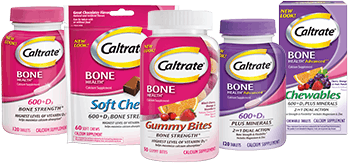
The calcium, vitamin D3 and other minerals^ you need to help support collagen production for stronger, more flexible bones*—all in an easy-to swallow tablet.

All the benefits of Caltrate 600+D3 Plus Minerals in a chewable tablet

Tasty and convenient with vitamin D3 to help maximize calcium absorption.*

Delicious gummy bites provide calcium plus vitamin D3 in three delicious fruity flavors
Get facts about bone health and resources like the Calcium Calculator.
Add ¼ cup of milk to your soup for an added calcium boost!


Trust Calcium Supplements to Help Fill Your Nutritional Gap
Are you getting enough calcium and vitamin D from your diet?
Follow Us
*
These statements have not been evaluated by the Food and Drug Administration. These products are not intended to diagnose, treat, cure or prevent any disease.
^
Refers to Copper, Magnesium, Manganese and Zinc
^^
A healthy diet that includes calcium along with a lifetime of regular exercise builds and maintains good bone health and may reduce the risk of osteoporosis later in life.
†
Per tablet; among leading calcium supplement brands.
‡
Compared to original Caltrate 600+D3 Plus Minerals tablets formula.
1
What We Eat in America, NHANES 2005-2006 report by the Centers for Disease Control and Prevention.
€
Refers to Caltrate 600+D3 Soft Chews and Caltrate Gummy Bites; both formulas not for use in children under 13. All other formulas for Adult Use only.
††
Excludes Caltrate 600+D3 Soft Chews Vanilla Crème and Caltrate 600+D3 Soft Chews Chocolate Truffle.
¥
Refers to Zinc, Copper, and Manganese.
+++
Refers to Calcium Carbonate; Excludes Caltrate Gummy Bites that are made with Tribasic Calcium Phosphate.
© 2020-2023 Haleon group of companies. All rights reserved. Trade marks are owned by or licensed to the Haleon group of companies. The content of this site is intended for US audiences only.
